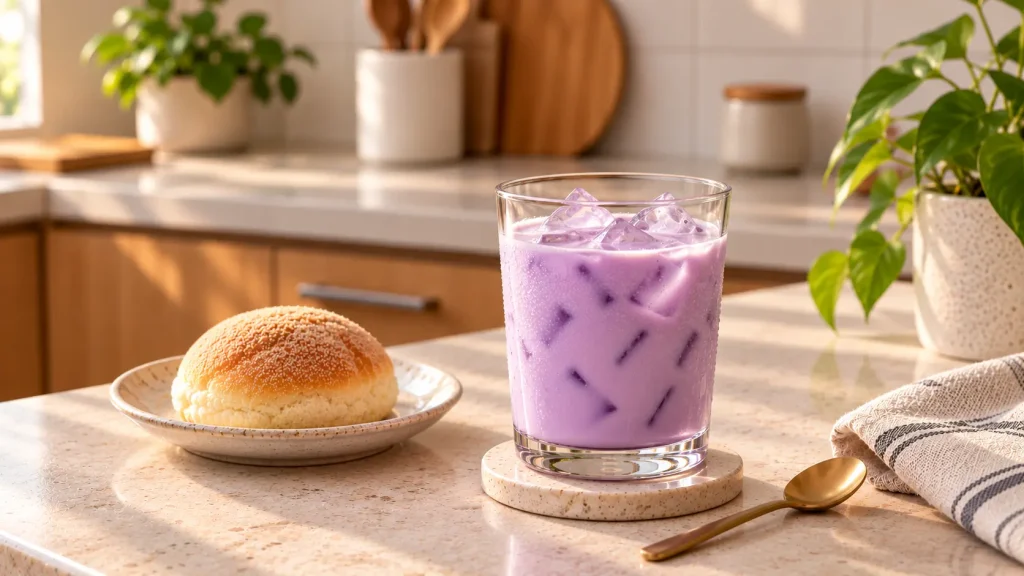
Ube gives a homemade latte a distinctive flavor and a beautiful purple hue, but there is much more to this ingredient than its color.
Long before ube appeared on modern café menus, it had an established place in Filipino food culture. Today, it is also used in contemporary milk-based drinks, including hot and iced lattes.
For this MyHomeDrinks recipe, we use pure, unsweetened ube powder to make a smooth ube base, then combine it with milk and optional sweetness. We’ll make the signature version without coffee so the ube remains at the center of the drink, then show you how to serve it hot or add espresso for a coffee version.
What Is an Ube Latte?
An ube latte is a milk-based drink flavored with ube. Ube is the name widely used in the Philippines for Dioscorea alata, a species of yam. The drink can be served hot or iced, and despite the word “latte,” it does not necessarily contain espresso.
At its simplest, an ube latte combines ube and milk, with sweetness adjusted to suit the ube product and your preference. Ube gives the drink its characteristic flavor and can create shades of purple that vary depending on the ingredient used.
Adding espresso changes the drink noticeably, bringing roasted and bittersweet coffee notes alongside the more delicate ube flavor. In this article, we treat that as a separate variation—a Dirty Ube Latte—rather than making coffee part of the base recipe.
Before we make either version, it is worth getting to know the ingredient itself. Ube is frequently confused with taro and purple sweet potato, but they are not the same thing.
What Exactly Is Ube?
Ube is a type of yam belonging to the species Dioscorea alata. Often called purple yam, it has a long history as a food crop in tropical Asia and an especially important place in Filipino cooking and food culture.
Ube grows as an underground tuber that is cooked before it is eaten. Although ube is best known for purple-fleshed varieties, flesh color can vary considerably between varieties.
Despite the similar color, ube is not a purple sweet potato. Yams and sweet potatoes belong to different plant families, and they differ in flavor, texture, and culinary use. This distinction becomes especially useful when shopping for ube powder or other ingredients for a latte.
Ube itself has longstanding culinary significance in the Philippines, while the ube latte is a much more recent café-style use of the ingredient. We’ll look more closely at that cultural story in the next section.
Is Ube Naturally Purple?
Purple varieties do. Their natural color comes from plant pigments called anthocyanins. These pigments contribute red, blue, and purple colors to many different plants.
The exact color of an ube latte can still vary. The variety of ube, how it has been processed, the amount used, and the other ingredients in the drink can all influence its appearance. A homemade ube latte may therefore be soft lavender, muted purple, or deeper violet rather than one fixed shade.
Color alone is not a reliable way to identify ube. Taro and purple-fleshed sweet potatoes can also appear in purple foods and drinks, even though they are botanically different ingredients. Later in the article, we’ll compare them side by side and explain what to look for when choosing ube for a latte.
Ube in Filipino Food Culture
For many people encountering ube through a latte today, the purple drink may be their introduction to the ingredient. In the Philippines, however, ube has a much longer culinary history.
Ube is used in a range of Filipino foods, but some of its best-known preparations are sweet. Among them is ube halaya, in which cooked ube is slowly prepared with sweetening and enriching ingredients until thick and smooth. Recipes and methods vary, and for some Filipino families, making halaya is also connected with celebrations, family traditions, and recipes passed from one generation to another.
Ube is also familiar in desserts such as halo-halo and ice cream, as well as cakes, pastries, and other sweets. These are just some examples of ube’s established place in Filipino food culture, long before purple lattes became familiar on international café menus.
From a Filipino Ingredient to a Modern Café Drink
The ube latte belongs to a newer chapter of this story. It should not be presented as a traditional Filipino beverage simply because its defining ingredient has deep roots in Filipino cooking.
Instead, the latte is a contemporary way of using ube: combining it with milk and, in some versions, espresso to fit the format of a modern café drink. Filipino cafés and food businesses are among those using ube in contemporary drinks and introducing the ingredient to new audiences. Its visibility has since expanded further through cafés and social media beyond the Philippines.
That wider popularity did not create ube’s culinary significance. It introduced more people to an ingredient that was already well established in Filipino food culture.
For our recipe, that distinction is worth keeping in mind. We are not recreating a traditional Filipino ube beverage. We are making a modern ube latte while recognizing the food culture in which its defining ingredient has long been valued.
What Does Ube Taste Like?
Ube has a distinctive flavor that is not easy to match to a single familiar ingredient. It is generally mild, with earthy, subtly sweet, and nutty characteristics, although flavor and aroma can vary between varieties and preparations.
The pronounced sweetness people may associate with ube desserts or drinks often comes from the way those foods are prepared rather than from the yam alone.
Ingredients such as sugar, dairy, coconut, and added flavorings can all shape the finished flavor of an ube-based food or drink. This helps explain why tasting ube in a less-sweetened preparation can be different from encountering it in ice cream, cake, or a commercial drink.
Why Ube Flavor Can Vary
Not every ube ingredient will taste exactly the same. The variety of yam, processing method, concentration, and any additional ingredients can all influence the flavor and aroma of the product you use.
Pure unsweetened ube powder, for example, is different from ube halaya, a sweetened ube mix, or an ube extract. Halaya is already a prepared food with other ingredients, while mixes and extracts have formulations that vary by product.
This matters when making an ube latte. Adding more vanilla or sugar can make a delicate ube drink sweeter without necessarily making the ube itself more noticeable. Starting with modest or optional sweetness gives the ube more room to define the drink.
Ube vs. Taro vs. Purple Sweet Potato vs. Okinawan Sweet Potato
Ube is often confused with taro and purple sweet potato, especially when these ingredients appear in colorful desserts and drinks. They may sometimes look similar after preparation, but they come from different plants and should not be treated as interchangeable.
Okinawan sweet potato adds another source of confusion. Despite its purple flesh, it is a sweet potato—not ube.
| Ingredient | Botanical Identity | General Flavor Profile | What It Means for a Latte |
|---|---|---|---|
| Ube | A yam, Dioscorea alata | Mild, subtly sweet, earthy, and nutty | The ingredient needed for an ube latte |
| Taro | Colocasia esculenta, grown for its edible corm | Mild, starchy, and earthy | A different ingredient with its own flavor; not another name for ube |
| Purple sweet potato | A purple-fleshed sweet potato, Ipomoea batatas | Sweet and earthy, with sweet-potato characteristics | Can make a purple milk-based drink, but it is not ube |
| Okinawan sweet potato | A purple-fleshed type of sweet potato, Ipomoea batatas | Sweet and starchy, with sweet-potato characteristics | Also a sweet potato rather than ube |
Flavor varies by variety, processing, and preparation, so these descriptions are general rather than absolute.
Ube
Ube belongs to the yam species Dioscorea alata. For an ube latte, this is the ingredient we are looking for. Its identity matters more than simply finding a purple ingredient.
Taro
Taro (Colocasia esculenta) is a different plant, grown primarily for its edible corm. It is used in many cuisines, including across parts of Asia and the Pacific, but it is not another name for ube.
Taro should not be identified by one expected flesh color. Depending on the variety, the corm can show white, yellow, pinkish, reddish, or purple tones. Prepared taro foods and drink ingredients can look different again, so color alone is not a reliable way to distinguish taro from ube.
Purple Sweet Potato and Okinawan Sweet Potato
Purple sweet potatoes belong to Ipomoea batatas. Their naturally pigmented flesh can give foods and drinks a strong purple color, which can make them easy to confuse visually with ube after preparation.
Okinawan sweet potato is also Ipomoea batatas. It is a purple-fleshed sweet potato, not ube, despite the occasional confusion between the terms “purple yam” and “purple sweet potato.”
How to Make Sure You’re Buying Ube
Do not identify an ingredient by purple color alone. Check the ingredient list and product description for ube or purple yam. If the botanical name Dioscorea alata is provided, it offers additional confirmation.
Then look at the rest of the ingredient list. Some ube products contain added sugar, milk powder, flavorings, coloring, or other ingredients. That does not automatically make them unsuitable for a latte, but it changes what you are working with and can affect sweetness, flavor, color, and preparation.
This becomes especially important when choosing between ube powder, halaya, extracts, and drink mixes—which we’ll look at next.
Which Ube Should You Use for a Latte?
Ube comes in several forms, including fresh or frozen yam, powder, ube halaya, extracts, and ready-made drink mixes. They are not interchangeable, and the form you choose affects both the preparation and the sweetness of your latte.
For this recipe, our preferred starting point is pure, unsweetened ube powder. It is convenient to measure for a home latte and allows us to control the ube, milk, and sweetness separately.
That does not make powder more traditional or more authentic than fresh ube or ube halaya. It is simply the most practical fit for the recipe we are making here.
Pure Ube Powder
Look for a pure, unsweetened ube or purple yam powder, preferably without added sugar or flavoring. Check the ingredient list rather than relying only on the color or front of the package.
Just as importantly, read the preparation instructions. Ube powders can be processed differently, so do not assume that every product behaves like an instant drink powder.
If your powder requires cooking or a specific rehydration method, follow the manufacturer’s directions rather than using the preparation method in this recipe unchanged.
Fresh or Frozen Ube
Fresh or frozen ube is another legitimate option, but it requires more preparation. The yam needs to be properly cooked before it is eaten and then processed to a consistency suitable for the drink.
Because cooked ube has a different water content and texture from dried powder, it is not a gram-for-gram substitute for the powder in this recipe. A latte made from fresh or frozen ube would need its own adjusted formula.
Ube Halaya
Ube halaya is a prepared Filipino food rather than plain ube. Recipes and formulations vary, but halaya typically combines cooked ube with sweetening and enriching ingredients to create a thick, rich preparation.
It can be used in modern ube drinks, but its existing sweetness, texture, and other ingredients need to be taken into account. For that reason, halaya should not be substituted one-for-one for the pure ube powder in this recipe.
Ube Extracts and Drink Mixes
Ube extracts, flavorings, and ready-made drink mixes are different products again. Their concentration and ingredients vary, and mixes may already contain sugar, milk or creamer ingredients, flavorings, or coloring.
They can be useful for their intended purpose, but they are not direct substitutes for pure ube powder. Follow the directions for the specific product rather than applying the measurements from this powder-based recipe.
Our Choice for This Recipe
For the MyHomeDrinks version, we use pure, unsweetened ube powder, while paying attention to the preparation instructions for the specific product.
This gives us control over the three main parts of the drink: the ube itself, the amount of milk, and the level of sweetness.
Next, we can turn those ingredients into our signature iced ube latte.
How to Make an Iced Ube Latte
This is our signature ube latte: a cold, milk-based version without coffee, so ube remains the defining flavor of the drink.
This formula is designed around pure, unsweetened ube powder that is suitable for direct rehydration. Because ube powders can differ in processing and preparation requirements, check the instructions for your specific product before you begin.
Ingredients
- 4 g pure, unsweetened ube powder
- 25 ml hot water, for a directly rehydratable powder
- 180 ml cold whole milk
- 0–5 ml vanilla syrup, optional and to taste
- 120–140 g ice
Method
1. Prepare the ube.
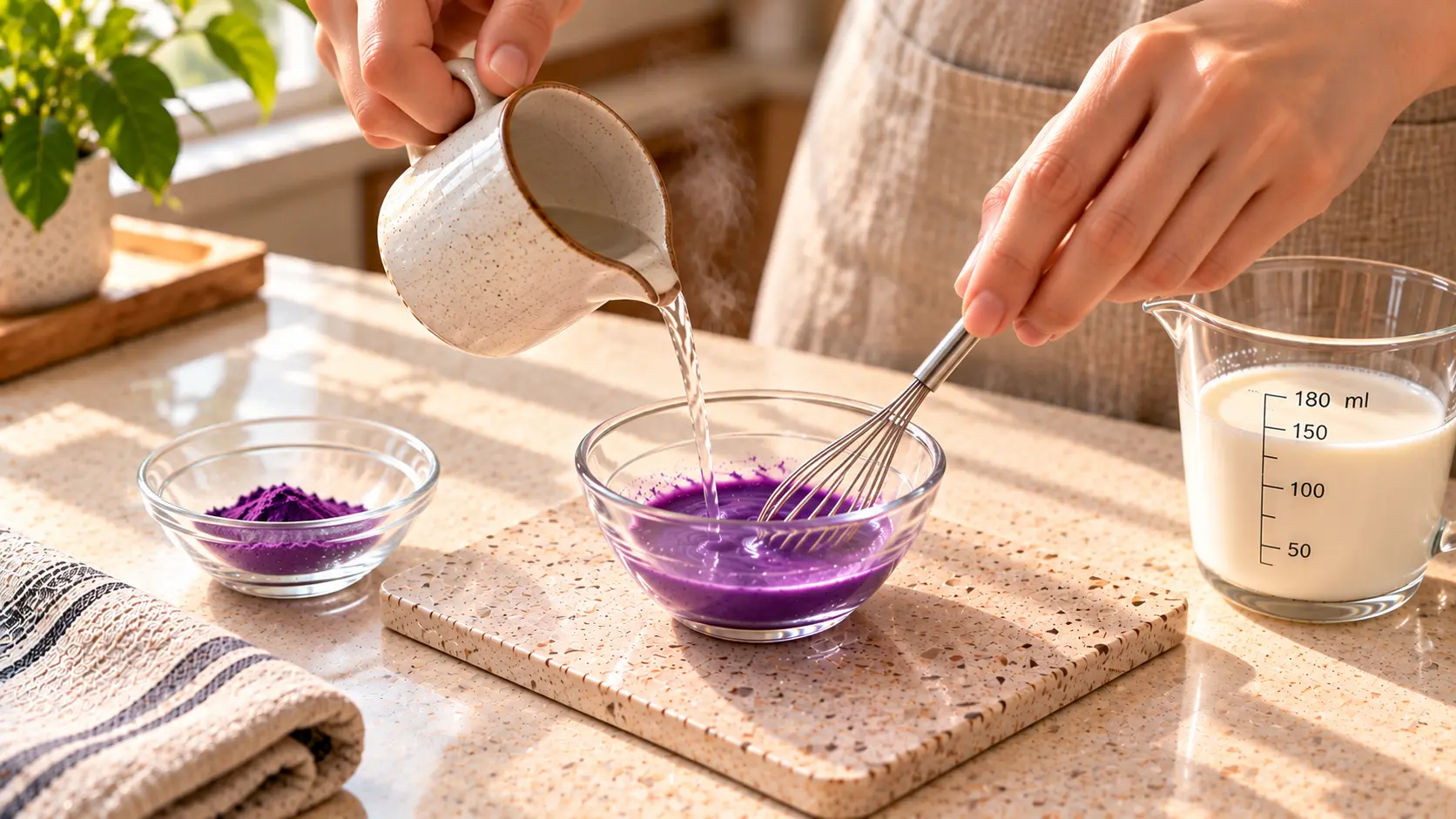
Place the ube powder in a small bowl or cup. If your powder is suitable for direct rehydration, add 25 ml hot water and whisk thoroughly until evenly combined. If your powder requires cooking or a substantially different rehydration method, prepare it according to the manufacturer’s directions and treat it as a different preparation rather than substituting it directly into this formula.
2. Adjust the sweetness.
Stir in up to 5 ml vanilla syrup, if using. Start with less, or leave it out entirely, then adjust to taste.
3. Add the milk.
Stir in a small amount of the cold milk first to loosen the ube mixture, then gradually add the remaining milk while mixing.
4. Add the ice.
Place 120–140 g ice in a serving glass.
5. Pour and serve.
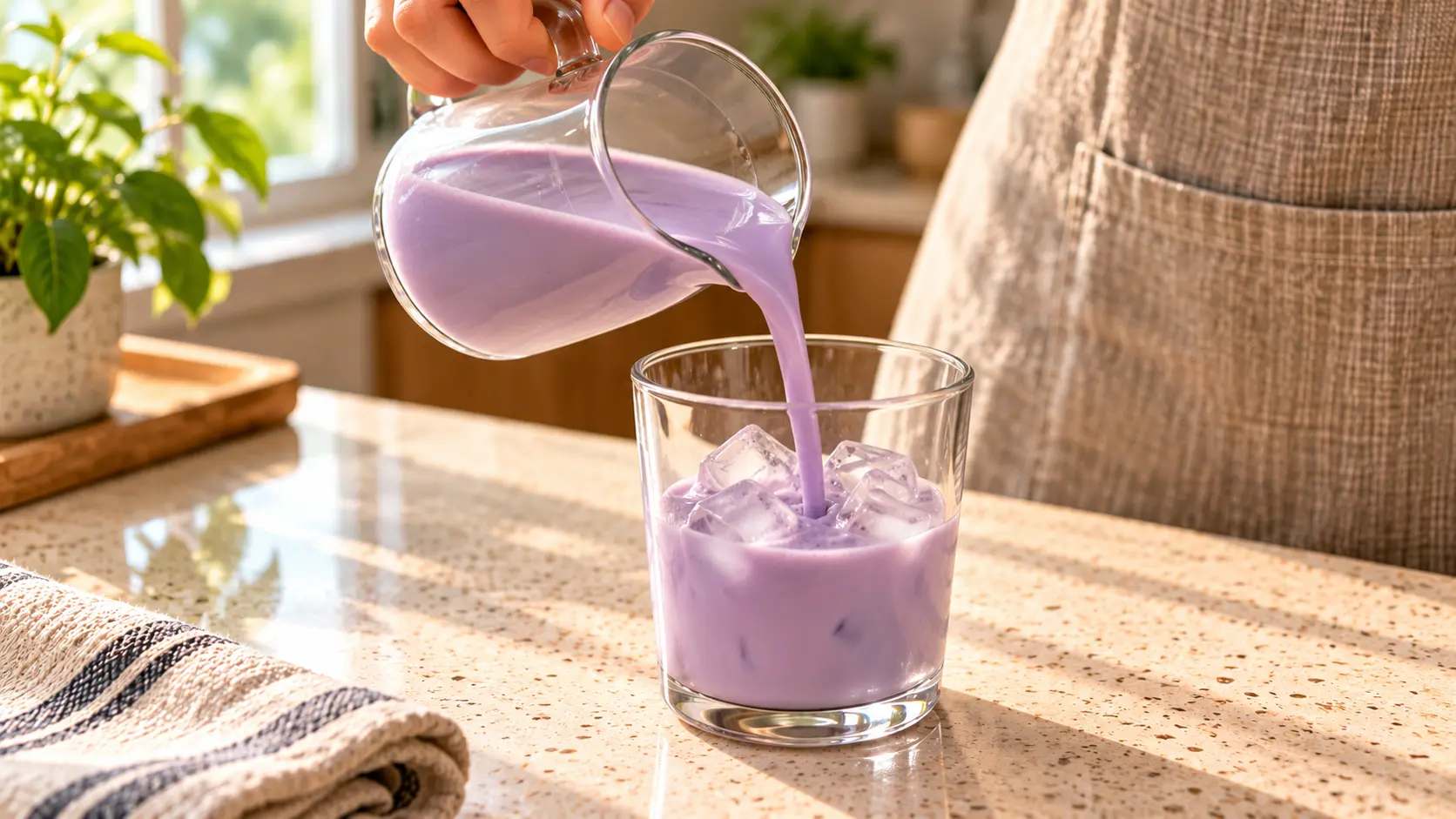
Pour the ube-milk mixture over the ice and stir before drinking.
What to Expect
Using the quantities above, the drink contains about 205 ml of liquid before optional syrup, or about 210 ml with the full 5 ml. Ice adds chilling and gradual dilution as it melts.
The finished color can vary considerably depending on the ube powder and the other ingredients in the drink, so a homemade ube latte does not need to reach one particular shade of purple.
Some ube powders may settle slightly over time. If that happens, simply stir the drink again.
The Reasoning Behind This Ube Latte
Our formula uses 4 g of pure, unsweetened ube powder with 180 ml of milk as a practical starting point for a home-sized iced latte.
For a directly rehydratable powder, mixing the ube first with a small amount of hot water helps distribute it before the full volume of cold milk is added. Adding a little milk first, then the rest gradually, also makes the mixture easier to combine.
Sweetness Stays Adjustable
The ube powder used in this recipe is unsweetened, so sweetness can be adjusted separately rather than built into the base formula.
The vanilla syrup is therefore optional and limited to a small amount. You can leave it out, start with less, or adjust it to taste depending on the ube powder you are using and the drink you prefer.
Milk Provides the Base
We use 180 ml of whole milk as the baseline for this version, giving the recipe a consistent starting point for both volume and texture.
Other dairy and plant-based milks can also be used, but changing the milk can change the flavor, sweetness, and texture of the finished drink.
Ice Adds Chilling and Dilution
The 120–140 g of ice chills the latte and gradually dilutes it as the ice melts.
The exact amount of melting will vary with factors such as the size and temperature of the ice, the temperature of the drink, and how long it sits before being finished.
Together, these choices keep the formula straightforward: ube defines the drink, milk forms the base, sweetness remains adjustable, and ice provides chilling with gradual dilution.
How to Make a Hot Ube Latte
The same basic ube-and-milk formula can also be prepared as a hot latte. Without ice, the hot version keeps the preparation simple: prepared ube, heated milk, and optional sweetness.
Ingredients
- 4 g pure, unsweetened ube powder
- 25 ml hot water, for a directly rehydratable powder
- 180 ml whole milk
- 0–5 ml vanilla syrup, optional and to taste
Method
1. Prepare the ube.
If your powder is suitable for direct rehydration, combine 4 g ube powder with 25 ml hot water and whisk until evenly mixed. If your powder requires cooking or a substantially different rehydration method, follow the manufacturer’s directions rather than substituting it directly into this formula.
2. Heat the milk.
Heat the milk to about 60–65°C (140–149°F). If you want a little foam, froth the milk lightly rather than creating a thick layer.
3. Adjust the sweetness.
Stir up to 5 ml vanilla syrup into the prepared ube, if using.
4. Combine.
Stir a small amount of the heated milk into the ube mixture first, then gradually add the remaining milk while mixing.
5. Serve.
Pour the latte into a heat-safe cup. If you frothed the milk, finish with the light foam on top.
Dirty Ube Latte: Adding Espresso
Adding espresso creates a coffee version of the ube latte. Because espresso brings a strong roasted flavor to the drink, we slightly reduce the milk rather than simply adding coffee to the full iced formula.
This also keeps the starting liquid volume close to the original iced version.
Ingredients
- 4 g pure, unsweetened ube powder
- 25 ml hot water, for a directly rehydratable powder
- 150 ml cold whole milk
- About 30 ml freshly brewed espresso
- 0–5 ml vanilla syrup, optional and to taste
- 120–140 g ice
Method
1. Prepare the ube.
If your powder is suitable for direct rehydration, combine 4 g ube powder with 25 ml hot water and whisk until evenly mixed. If your powder requires cooking or a substantially different rehydration method, follow the manufacturer’s directions rather than substituting it directly into this formula.
2. Adjust the sweetness.
Stir in up to 5 ml vanilla syrup, if using.
3. Add the milk.
Stir a small amount of the cold milk into the ube mixture first, then gradually add the remaining milk while mixing.
4. Add the ice.
Place 120–140 g ice in a serving glass and pour in the ube-milk mixture.
5. Add the espresso.
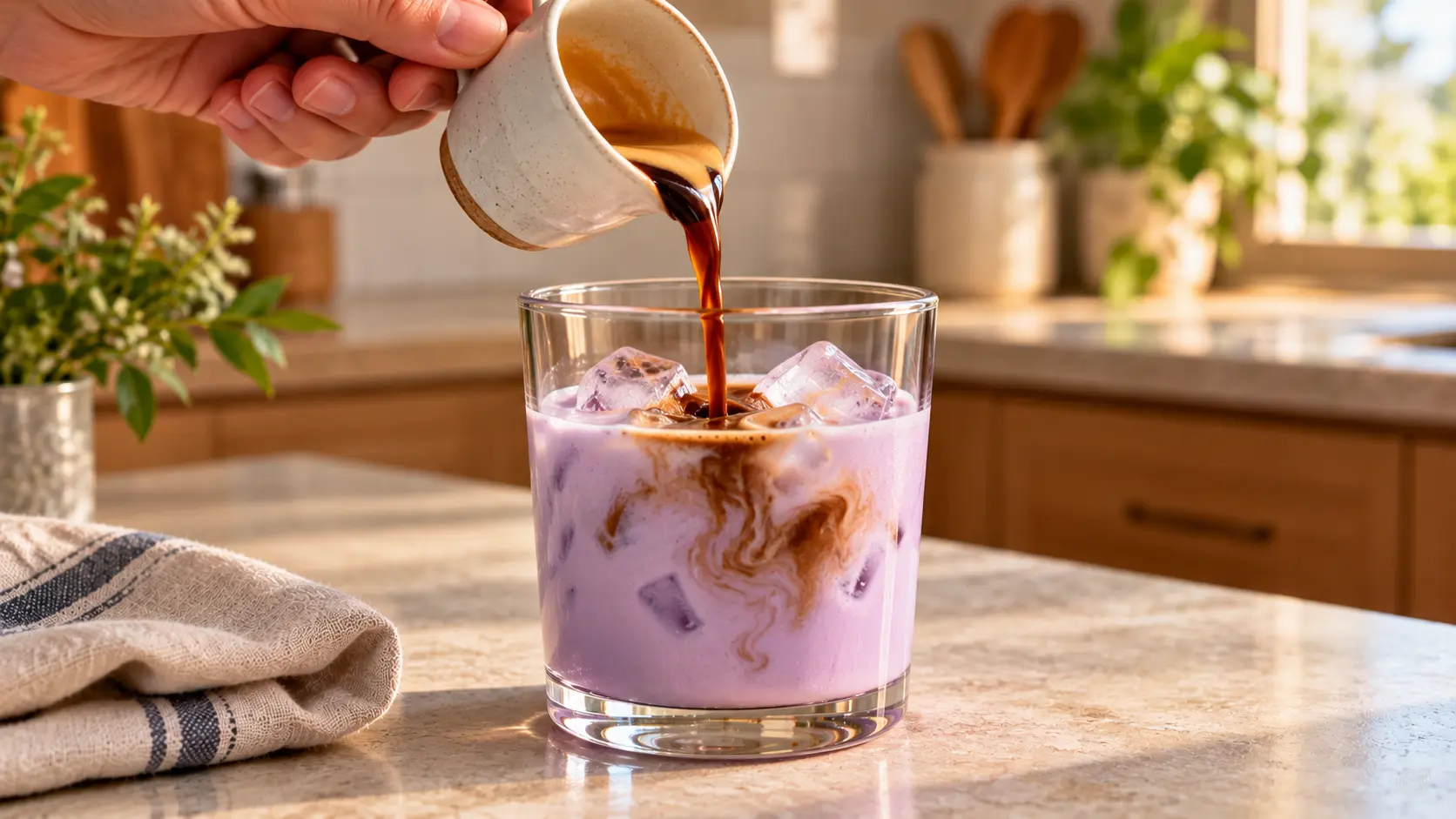
Prepare about 30 ml of espresso and pour it over the drink. Stir before drinking so the espresso, ube, and milk are evenly combined.
Choosing Espresso for an Ube Latte
For this version, an espresso with chocolate, caramel, or nutty characteristics is a practical starting point.
This is a flavor preference rather than a rule, so use an espresso you already enjoy if you prefer a different coffee profile.
Adding espresso can also change the appearance of the latte. Once the coffee is mixed through the drink, the purple color may become more muted or brown-toned than in the coffee-free version.
Ube Latte Troubleshooting
Ube powders can vary in texture, concentration, and preparation requirements, so two products may behave differently in the same drink. If your latte does not turn out as expected, start with the problem you can see or taste rather than automatically adding more ube.
My Ube Latte Is Clumpy
If the powder forms small clumps, it may not have dispersed evenly before the milk was added.
For a directly rehydratable powder, whisk it thoroughly with the hot water first, then add a small amount of milk and mix again before gradually adding the rest.
If the package requires cooking or another preparation method, follow those directions instead. Trying to treat every ube powder as an instant powder can produce poor results.
My Ube Latte Feels Grainy
Some ube powders naturally produce more noticeable texture than others, depending on how they are processed and prepared.
Check the product directions first. If the powder is intended for direct rehydration, mixing it thoroughly before adding the full amount of milk can help improve dispersion.
Adding more powder is not necessarily the solution; it also increases the amount of solids in the drink.
The Ube Settles at the Bottom
Some ube powders may settle after the drink sits for a while.
Stir the latte before drinking and again if it has been sitting for a while. Settling by itself does not necessarily mean the drink was prepared incorrectly.
My Ube Latte Is Too Thick
First, check that you are using the type of ube powder specified in the recipe and that it has been prepared according to its directions.
Using more powder than the recipe calls for, or substituting a thicker ube product such as halaya, can change the consistency of the drink.
If you are using the intended powder and the drink is still thicker than you prefer, add a small amount of milk and mix again, adjusting gradually rather than adding a large amount at once.
The Ube Flavor Is Too Weak
Before adding more powder, check what kind of ube product you are using. Products differ in concentration and may contain other ingredients that affect the finished flavor.
Also consider the amount of sweetener. Adding more syrup can make the drink sweeter without necessarily making the ube itself more noticeable.
If you are making the Dirty Ube Latte, espresso introduces another strong flavor, so the ube may seem less prominent than it does in the coffee-free version.
The Latte Is Too Sweet
If you are using the pure, unsweetened powder specified in this recipe, reduce or omit the optional vanilla syrup.
If you are using an ube mix, extract, or halaya instead, check whether it already contains sugar or other sweetened ingredients. These products cannot be substituted directly into this powder-based formula without adjusting the rest of the recipe.
The Color Is Not Bright Purple
A vivid purple color is not a requirement for a successful ube latte. The appearance can vary with the ube variety, processing method, concentration, milk, and other ingredients.
Do not add more ube solely to chase a particular shade of purple. In the Dirty Ube Latte, espresso can also mute the purple appearance or shift it toward a browner tone.
Ube Latte FAQ
Does an Ube Latte Contain Coffee?
Not necessarily. An ube latte is a milk-based drink flavored with ube, and it can be made without coffee.
The main recipe in this article does not contain espresso. If you want a coffee version, you can add espresso as shown in the Dirty Ube Latte variation.
Does an Ube Latte Have Caffeine?
The main ube latte in this article does not include a caffeine-containing ingredient when made with the ingredients specified in the recipe.
If you use a flavored or blended commercial ube product, check its ingredient list separately, since formulations can vary. The Dirty Ube Latte does contain caffeine because espresso is added.
Is Ube the Same as Taro?
No. Ube and taro come from different plants.
Ube is Dioscorea alata, a species of yam, while taro is Colocasia esculenta, grown primarily for its edible corm. They should not be treated as interchangeable simply because both can appear in purple-colored foods and drinks.
Can I Use Ube Halaya Instead of Ube Powder?
Ube halaya can be used in modern ube drinks, but it is not a direct substitute for the pure, unsweetened ube powder in this recipe.
Halaya is already a prepared food and can contain sweetening and enriching ingredients. Its texture and formulation also vary, so a halaya-based latte needs adjustments rather than a one-for-one substitution.
Can I Make an Ube Latte With Plant-Based Milk?
Yes. Plant-based milk can be used, but changing the milk can also change the flavor, sweetness, and texture of the latte.
If you want to control the sweetness separately, an unsweetened plant milk can make that easier. Adjust the drink to taste based on the milk you use.
Can I Make This Ube Latte Hot?
Yes. The article includes a hot version made without ice, using heated milk and the same ube-based approach.
Final Takeaway
An ube latte is more than a colorful café drink. Its defining ingredient, ube (Dioscorea alata), has a much longer history in Filipino food culture than the modern ube latte.
For a homemade version, the most important starting point is knowing what kind of ube product you are using. Pure, unsweetened ube powder gives this recipe a practical baseline, while halaya, extracts, mixes, and fresh or frozen ube are not direct substitutes and require their own preparation or recipe adjustments.
From there, the drink can stay simple: ube and milk with sweetness adjusted to taste. Serve it over ice, make it hot, or add espresso for the Dirty Ube Latte variation.
Whichever version you make, let the ingredient—not just the purple color—define the drink.